AI Is a Multiplier. What Is It Multiplying in Your Bid Team?
Most bid teams plug AI into a writing workflow and expect commercial outcomes. But tendering is not a writing problem. It’s a sales problem. Writing is just the visible output of upstream decisions.
The assumption:
AI makes bids better because it writes faster and cleaner.
And the truth:
AI multiplies whatever system it sits inside.
Drop AI into a weak system and it accelerates the weakness.
What Does AI Multiply?
It multiplies what you are doing.
In most organisations, tendering resembles a production line:
Tenders are discovered late. Deadlines dictate behaviour. Qualification is a nod rather than a comprehensive decision. Risk surfaces halfway through the draft. Evidence lives in folders no one fully trusts. Positioning is assembled under pressure because the clock is louder than the strategy.
Add AI and you get more words, faster. You also get faster escalation of poor judgement. More confidence in bids that should have been killed. More output applied to unwinnable work. More time on a project that just fills a column for the buyer.
It can feel like progress. But that can be like flooring an accelerator without steering.
Why Better Writing Doesn’t Always Change Outcomes
Another hard truth: Evaluators are not scoring literary quality. They are assessing delivery risk, contextual fit, past proof, capability evidence, and commercial alignment.
Once a response clears baseline clarity, incremental improvements in tone and structure have diminishing impact.
AI can accelerate clarity. A simple LLM cannot compensate for weak positioning, poor timing or thin evidence.
That is the ceiling for tacked-on AI. Writing improves, but outcomes stay flat.
What Changes When Tendering Is Run Like Sales?
Great sales teams begin with judgement, not output.
The first move is not to write, but to decide. Some deals are cut before a word is drafted. Buyer risk is interrogated early. Past wins are mined for proof and pattern. The pipeline is treated as a portfolio of probabilities and trade-offs, as opposed to a queue of documents waiting for attention.
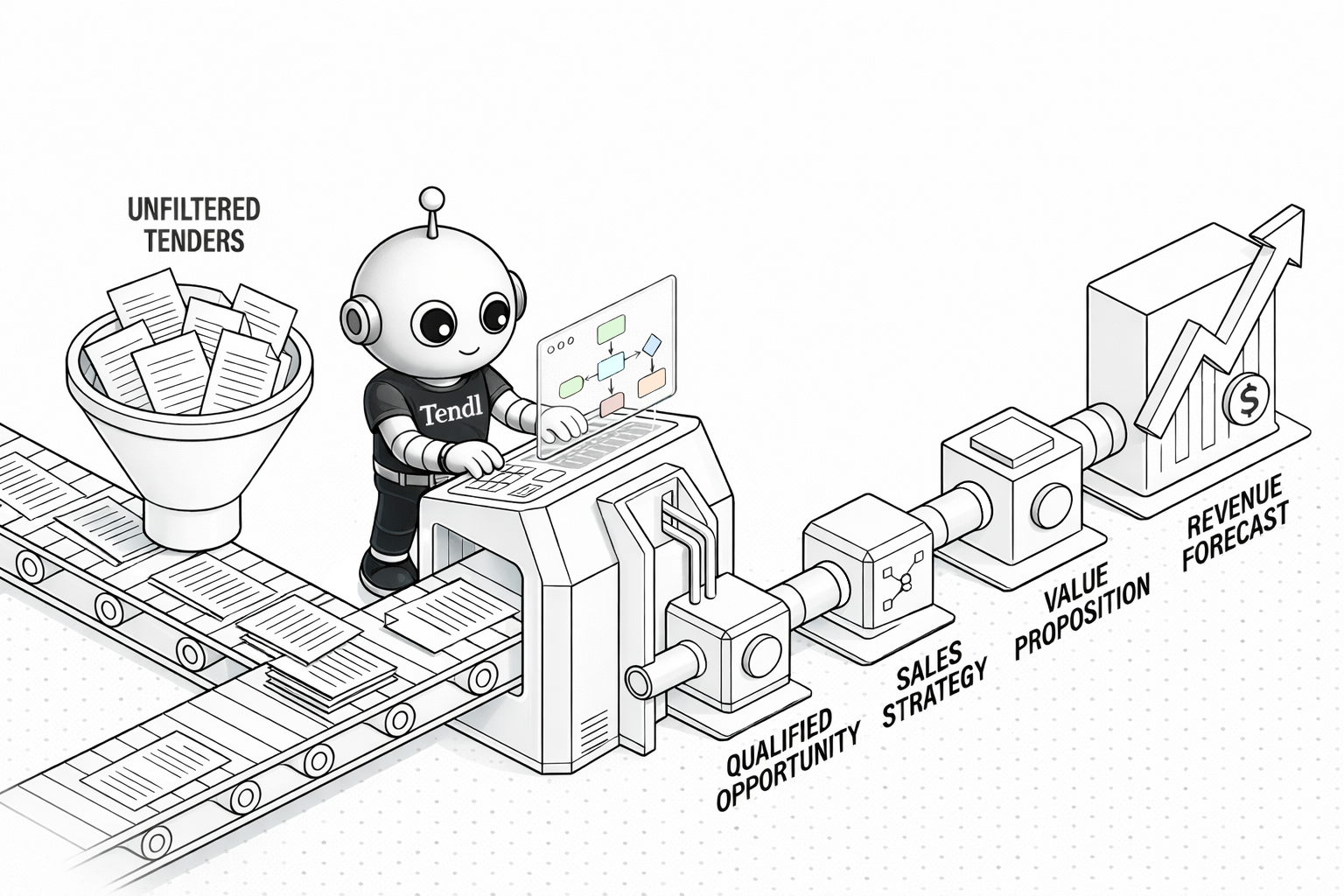
When tendering runs on that commercial footing, risk surfaces before resources are burned. Writing becomes the final layer of a decision already made. In that structure, AI stops behaving like a typing assistant and starts behaving like a revenue multiplier.
How Does This Work With The Tendl Way?
Tendl is built on a single assumption: tendering is first and foremost a sales function.
The improvement is not just speed, it is clarity of judgement.
- Every tender opportunity is visible for teams to discover in line with commercial interests.
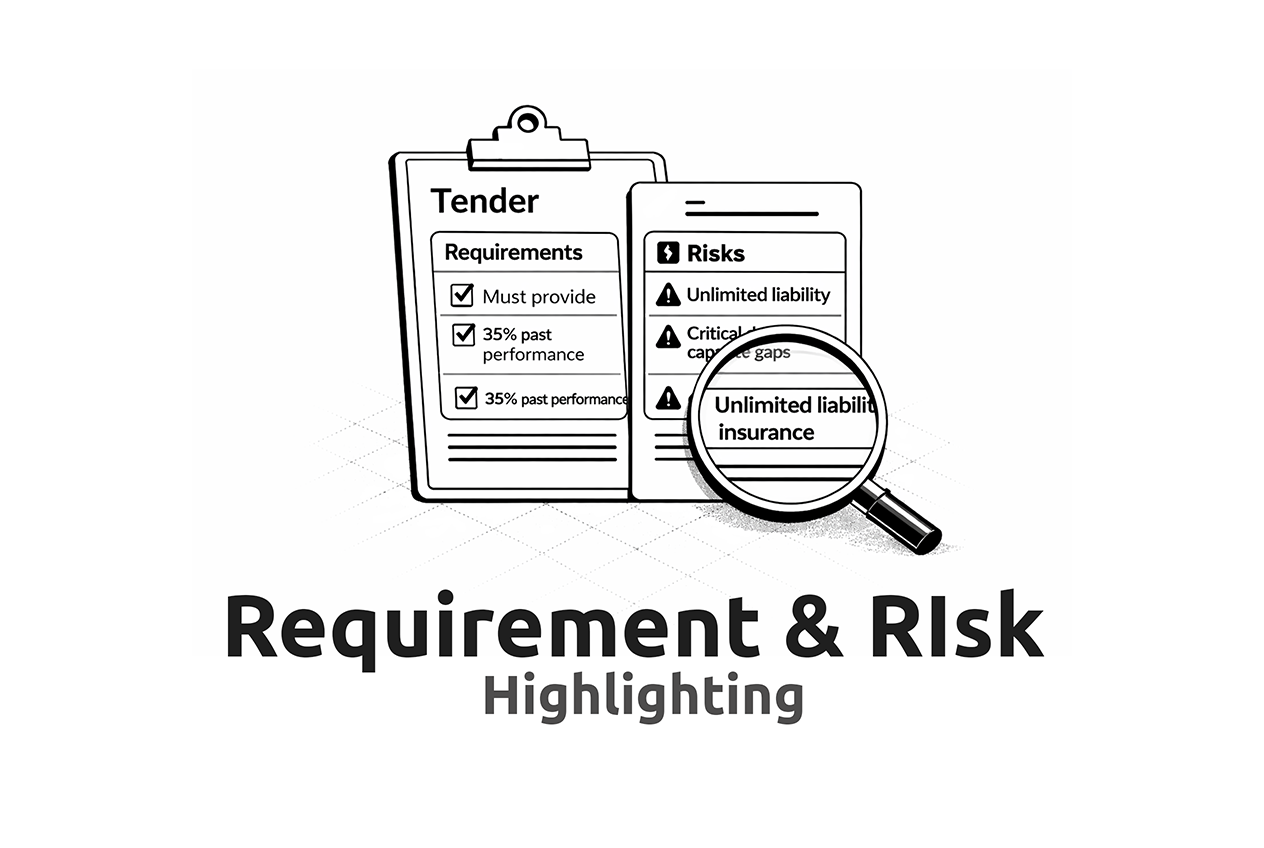
- Risk becomes visible before drafting begins.
- Go or No-Go decisions are structured around commercial reality.
- Proven, high-scoring evidence is governed and reused with intent.
- Every opportunity sits inside a weighted pipeline where trade-offs and probabilities are explicit.
In that environment, speed has context. AI assembles and accelerates work that already has direction. It removes friction from a system that knows what it is trying to achieve.
When AI multiplies a sales system, both velocity and win probability increase.
The Real Takeaway
AI strengthens disciplined systems and makes fragile ones obvious.
In a reactive process, it accelerates the reaction. In an undisciplined one, it compounds waste. In a commercial system built on qualification, risk visibility and proof, it behaves like leverage.
AI is a multiplier.
Decide like a world class sales team. Then draft like one.